Free resume checker — find out what your résumé is costing you
A resume gap analysis in about 20 seconds: an honest resume score out of 100, which bullets are dead weight, and rewrites for the weakest ones. Free, no signup.
- Resume or CV · PDF, DOCX or TXT
- Rewrites never invent numbers
- Updated September 2026
Your file is held for 30 days to produce the report, then deleted automatically — or delete it yourself any time from your results page. Never sold or used to train models — privacy policy.
Targeting a specific job?
OptionalPaste the posting and we score your résumé against it term by term, instead of judging it in the abstract.
Add your resume to continue
Free, no signup. We store your résumé for 30 days to generate this report — delete it any time from your results page, or see our privacy policy.
What this resume checker looks at
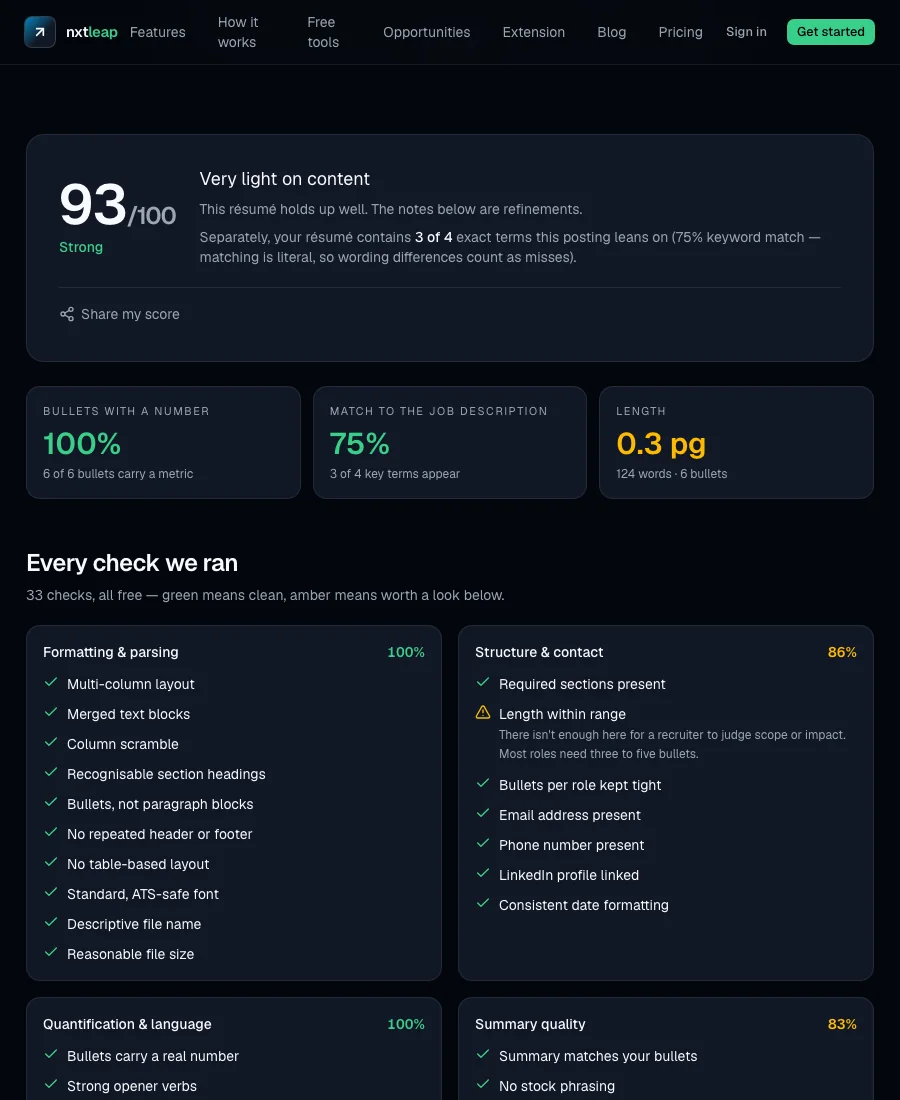
Every free resume review covers the same six things — the counted figures are computed from your file, not estimated.
Quantification rate
We count how many of your bullets carry a real number — a percentage, a currency figure, a multiple, a headcount, a timeframe. A lone '1' doesn't count. This is the single strongest signal separating a bullet that reads as an achievement from one that reads as a job duty, and it is counted, not estimated.
ATS keyword coverage, when you paste a job description
Paste the posting and we match its key terms against your résumé literally, then report the percentage and list exactly which terms are missing. Exact string matching, computed in code — run it twice and you get the same answer. Without a job description this section is skipped rather than guessed at.
Section-by-section grades
Summary, skills and experience are graded separately, each with the specific problems found and the single highest-value fix. A strong experience section doesn't rescue a summary that opens with a job title instead of a position.
Rewrites for your weakest bullets
For up to eight of the weakest lines you get the problem, the question that unlocks what's missing, and a rewritten version. Where a rewrite needs a number your résumé doesn't contain, it leaves a visible placeholder like [X%] and asks you for it. It will not invent a figure — a fabricated metric only sets you up to fail the interview it wins you.
How the file itself parses
Multi-column layouts often extract with the dates detached from the roles they belong to. The text isn't garbled, just re-ordered, so it looks fine while an applicant tracking system reads your achievements under the wrong employer. We detect that and tell you, because no amount of rewriting fixes a file that parses wrong.
An honest score, not a flattering one
A score that lands in the seventies whatever you upload tells you nothing. A résumé with no metrics and no recognisable sections scores in the forties here. Every number the report states as fact is counted from your document; anything the AI judged is labelled as its opinion.
Applying to one specific posting? The ATS checker matches your résumé against that job term by term. For how the two comparisons differ, read resume vs job description: running a gap analysis. Once you know what to fix, resume tailoring rewrites the weak bullets against a specific role, and the AI resume builder builds the Achievement Bank they are drawn from.
Why most résumés fail before a person reads them
Most résumés are not rejected because the person is unqualified. They are rejected because the document fails to make the qualification legible — first to software, then to a recruiter giving it a few seconds. Both failures are diagnosable, and both are fixable without changing a single fact about your career.
The first reader is usually not a person
Large employers run applications through an applicant tracking system that parses your file into structured fields before anyone sees it. Parsing is where most of the damage happens. A two-column layout, a header in a text box, dates in a sidebar — these look deliberate to you and arrive scrambled to the parser. If your dates detach from your roles, your five years at one employer can read as five unrelated stints.
This is why the analysis checks how your file extracts before it judges anything you wrote. A résumé that parses badly cannot be fixed by better bullets. If you want the same check aimed at one specific posting rather than the whole document, use the ATS resume checker; for what a coverage number does and does not mean, see what a good ATS score actually means.
The second reader is skimming for evidence
Once a human opens it, they are scanning for proof. "Led the migration" and "Led a six-person migration that cut deploy time 40%" describe the same work; only one of them is evidence. The gap between them is almost never knowledge — the person knows the number — it is that nobody asked them for it while they were writing.
That is what the quantification rate measures: not whether you are impressive, but how much of what you did survived onto the page in a form someone else can verify.
Where the words themselves cost you
- Openers that describe duties, not decisions. "Responsible for" and "worked on" say a role existed. "Led", "rebuilt", "negotiated" say you made a call.
- Hedged numbers. "~30%" reads as a guess. If you can defend the figure, state it; if you can't, cut it rather than soften it.
- A summary that opens with a job title. The first line is the most-read sentence on the page and is usually spent restating what the next line already says.
- Generic skills groupings. "Analytical Skills" tells a reader nothing and matches no posting. Real capability groups do both.
What to fix first
Take the findings in the order the report gives them. Anything flagged about the file itself comes first — a parsing problem invalidates everything downstream. Then the bullets with no number, starting with your most recent role, because that is where attention concentrates. Structural changes come last: they take the most rewriting and move the needle least on the first screen.
If you are applying to something specific, paste the job description. Without one the report judges your résumé on its own terms, which is useful but general. With one, it can tell you which of that posting's terms are genuinely absent from your document — a fix list rather than an assessment.
One thing worth saying plainly: adding a keyword you cannot back up in conversation is not optimisation, it is a trap you set for yourself. Use the missing-terms list to find real experience you failed to describe, not to claim experience you don't have.
The gaps we see most, by function
Patterns that come up again and again in the résumés run through this tool.
Software Development
- Scale claimed without a figure — "high traffic" with no requests, latency or data volume behind it
- The system is described but never named: "worked on the backend" instead of the service and what it carried
- Tools the posting asks for are absent from the résumé even when the person used them daily
- Leadership bullets with no team size, so "led" could mean two people or twenty
Product
- Outcomes with no movement attached — shipped, launched, drove, with no activation, retention or revenue delta
- Experiments described without results: "ran A/B tests" and nothing about what won
- Ownership softened to "contributed to" or "supported" where the person actually decided
- Discovery and prioritisation work missing entirely, though it is most of the job
Data
- Models without performance figures — no accuracy, precision, lift, or baseline to compare against
- Pipeline scale unstated: rows, frequency, latency, cost
- The business consequence missing — a model improved, and nothing about what that changed
- Tooling listed as a flat skills dump rather than tied to the work it was used for
Business
- Client and engagement anonymised into nothing — "a leading firm" with no size or sector signal
- No P&L consequence: cost taken out, revenue unlocked, margin moved
- Three-line bullets where the convention is one, burying the finding under the method
- Recommendations described without whether they were adopted
Design
- Craft described, impact omitted — a redesign with no completion, conversion or support-volume change
- Research effort with no decision attached to it
- Scope unclear: whether the person owned a flow, a surface, or a product
- No mention of who they worked with, which is most of what seniority is judged on
Marketing
- Channel work without economics — spend, CAC, ROAS, or pipeline contribution
- "Grew" with no baseline, so the number is unreadable
- Campaigns listed as activity rather than outcome
- Ownership of budget or team left implicit
Common questions about this resume checker
- What is resume gap analysis?
- Comparing what your résumé currently says against what a target role actually asks for. A thorough one covers three things: which of the posting's terms are literally absent from your résumé, which bullets describe duties rather than outcomes with a real number behind them, and whether the file itself parses in the right order. This tool runs all three on an upload in about twenty seconds.
- What is a good resume score?
- The overall score is out of 100. 85 and above reads as Strong — the notes are refinements. 70 to 84 is Solid, with a few specific things costing you interviews. 50 to 69 is Needs work: the substance is there but the presentation is losing recruiters. Below 50 is At risk. A résumé with no metrics and no recognisable sections typically lands in the forties. Length is judged against your career stage, read from the dates on your roles: a fresher needs roughly half a page, someone with five or more years at least three-quarters of one, and a résumé too thin for its stage can't score above Needs work.
- Does this check for employment gaps on my resume?
- No. "Gap" here means the distance between what your résumé says and what a recruiter or a posting needs to see — missing numbers, weak phrasing, absent keywords, parsing problems. It doesn't flag breaks between jobs. If you have a career break, list it like any other entry, with dates and one line on what you did, rather than leaving an unexplained hole.
- How is this different from the ATS resume checker?
- Same engine, different question. This resume checker reviews the document itself — metrics, phrasing, section quality, rewrites for weak bullets — and works with or without a job description. The ATS resume checker is aimed at getting through screening software for one specific posting: file parsing and keyword match first. Use this one when reworking your resume; use the ATS checker before you apply to a particular role.
- Does this work for a CV as well as a résumé?
- Yes. Outside the US the two words usually describe the same document, and nothing here reads the label — the quantification count, the section grades and the parse check all work the same way on either. The conventions applied are the US and UK ones that applicant tracking systems expect, so a photo or a two-column layout will be flagged even where those are locally normal. Treat that as information about parsing rather than about your market.
- Which file formats can I upload?
- PDF, .docx and .txt. PDF is the common case and the one where the parse check matters most, since multi-column layouts, tables and text boxes are what usually break extraction. A .docx or .txt generally parses cleanly because there is no layout-to-text step to get wrong.
- Is this resume checker really free?
- Yes. You get the full report — score, findings, section grades and bullet rewrites — without signing up or entering an email.
- Does it check ATS keywords too?
- Yes, when you paste a job description: it runs exact keyword matching between a job description you paste and your résumé text. It's computed in code, not estimated by a model — and it is not a simulation of any particular applicant tracking system, since every employer configures theirs differently. If you don't paste a job description, that section is skipped rather than guessed at.
- Will it invent numbers for my bullets?
- No. Where a rewrite needs a metric you haven't given, it leaves a visible placeholder like [X%] and asks you the question that fills it. Inventing a figure would only set you up to fail the interview it wins you.
- What happens to my résumé?
- It's stored for 30 days to generate your report, then deleted automatically — or delete it yourself immediately from your results page with one click. It is never sold or used to train models — see the privacy policy for exactly what we hold.
- How is this different from pasting my résumé into ChatGPT?
- A general chatbot gives you an opinion. This counts things: what share of your bullets carry a number, which of a posting's terms are literally absent, whether your file parses in the right order. Those are reproducible — run it twice and you get the same answer. The written critique is clearly separated from the counted figures so you can tell which is which.
- How long does it take?
- About twenty seconds end to end. Your browser reads the PDF locally, which is the fast part, and the written critique takes most of the remaining time.
- How many résumés can I run?
- Enough to compare a few versions — the limit is roughly five uploads an hour from one connection, which keeps the tool free and available without an account. If you hit it, wait a little and try again.
- What do I do after I get my results?
- The report is written to be actionable on its own: fix the file problems first, then the bullets with no number. If you'd rather not do it by hand, nxtleap rewrites your résumé against a specific job while keeping every number you can actually defend. Your upload carries over, so you don't start from scratch.
Check your resume now
An honest score and rewrites for your weakest bullets in about 20 seconds.
Check my resume free