Free ATS resume checker — get your ATS score and every keyword gap
Upload your resume and get your ATS score, formatting fixes, and exact keyword gaps — free, in about 20 seconds.
Want the whole résumé reviewed rather than matched to one posting? Run the full gap analysis.
What is an ATS? Full form and meaning
ATS stands for Applicant Tracking System — the software companies use to collect, parse and rank job applications before a recruiter reads them. In a resume context, "ATS" means the screening step your file goes through first: the system pulls plain text out of your PDF or DOCX, sorts it into sections, and matches it against the keywords in the job description.
An ATS-friendly resume is one that survives that step: a single-column layout, standard section headings, a text-based file rather than a scanned image, and the role's real keywords used in context. An ATS score is a checker's estimate of how well your resume does both — how cleanly it parses, and how closely it matches the job. Real ATS platforms don't show candidates a score; a resume ATS checker like this one shows you what they're likely to see. For the full walkthrough, read what an ATS is and how it reads your resume.
What the ATS resume checker analyses
How to check your resume's ATS score
- 01
Upload your résumé
Any existing résumé, as PDF, DOCX or TXT. You don't need to rebuild anything in nxtleap first — the checker works with whatever you already send to employers.
- 02
Paste the job description (optional)
Copy the full posting from LinkedIn, a careers page or any job board. Skip this and you still get a full ATS-readiness score — add it to also see your exact keyword match against that specific role.
- 03
See your results
Your keyword coverage score, formatting grade and gap list appear in about 20 seconds. Matched terms are highlighted, missing ones are listed with why they matter, and formatting problems are flagged with the fix.
What you get, and what we do with your file
Built for how ATS software actually reads a file
Greenhouse, Workday, Lever, Ashby, iCIMS, Taleo and standard career pages all extract plain text before anything else happens. The checker flags the layout problems that break that step: multi-column blocks, ruled tables, missing section headings, repeated headers, and non-standard fonts.
No account needed to run a check
Paste, upload and read your result without signing up. An account is only needed to save results and use the tailoring that fixes the gaps.
Exact match, plus an AI read of context
The headline score is an exact-match count — the same mechanical comparison an ATS makes. A separate view judges whether each skill is actually evidenced, so you see both what the software counts and what a recruiter would notice.
Part of a complete workflow
Gaps the checker finds become tailoring targets in Matchmaker — not a list you are left to solve alone.
Nothing locked
33 checks, every one of them free on every report — no PRO upgrade, no paywall on any result.
How Applicant Tracking Systems actually work
Most applications never reach a recruiter. Before a hiring manager reads a word, an Applicant Tracking System — the software that processes applications at most companies — has already sorted, ranked and frequently set aside your résumé.
An ATS extracts the text from your file and compares it against the skills, titles and qualifications the hiring team specified. If the right terms aren't there, the résumé scores low on relevance. If the layout can't be parsed — multi-column blocks, tables, headers in text boxes, unusual fonts — it may not parse at all, and a résumé that fails to parse can score nothing regardless of how strong the experience behind it is.
That is the system working as intended: narrowing hundreds of applications to a shortlist. The problem is that almost no candidate knows what their résumé looks like to the parser. For the full explanation, see what an ATS is and how it reads your resume, which keywords actually matter, and what a good ATS score really means.
Every check this page runs — nothing locked
33 checks, across five categories, every one of them free on every report — no PRO upgrade, no locked sections.
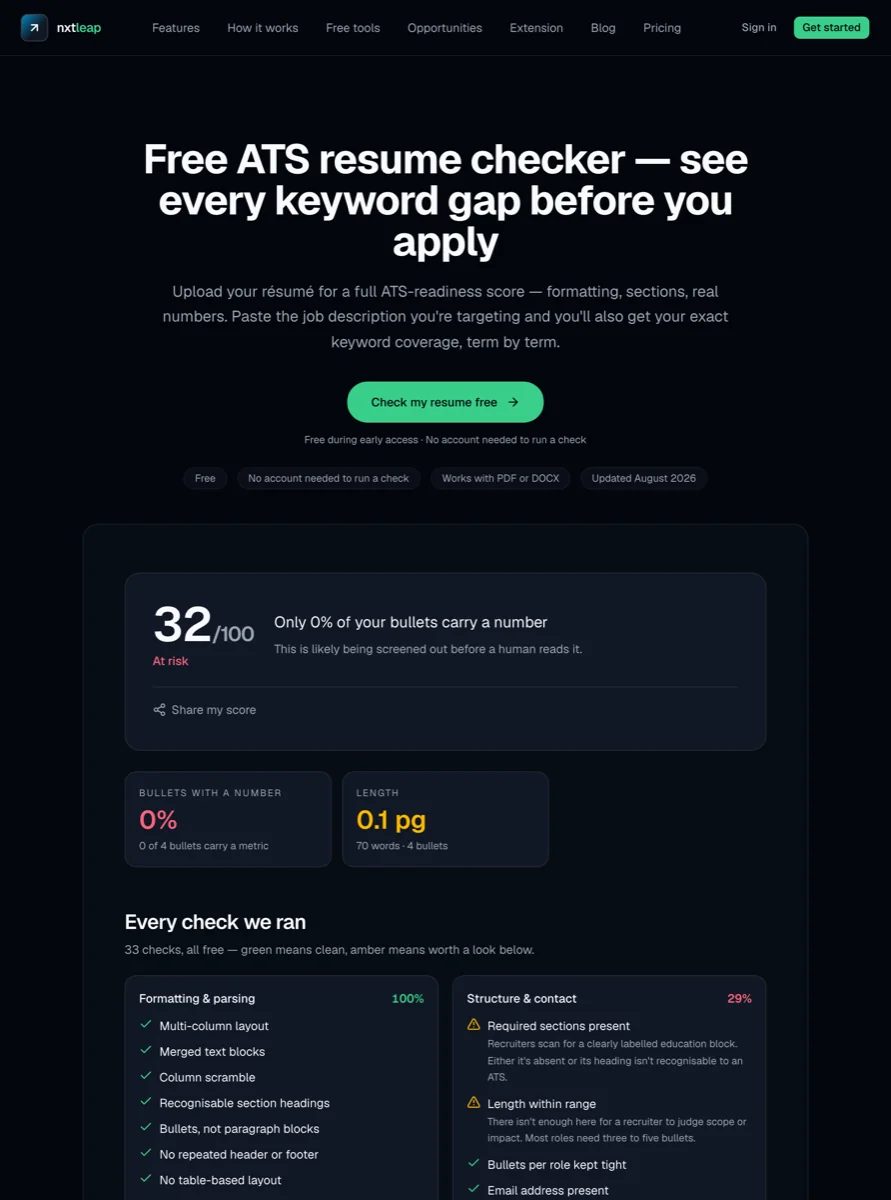
- Multi-column layouts that scramble reading order
- Merged text blocks where line breaks were lost
- Column scramble — dates and titles separated from the bullets they belong to
- Missing or unrecognisable section headings
- Dense paragraph blocks instead of bullets
- A running header or footer repeated on every page
- Table-based layout (ruled rows and columns, not just aligned text)
- Non-standard fonts an ATS parser may not render correctly
- A generic file name ("resume.pdf") that gets lost among identical uploads
- A file larger than most résumés need — usually embedded images some ATS uploaders choke on
- Missing sections (summary, experience, education, skills)
- Length — too long past two pages, too thin under half a page
- A single role crowded with more than 8 bullets
- Email address present and reachable
- Phone number present
- LinkedIn profile linked
- Date ranges written in more than one style across your roles
- Share of bullets that carry a real number
- Weak or passive opener verbs ("responsible for", "worked on")
- The same lead verb repeated across bullets
- Filler phrases that add length without information
- Hedged numbers ("~", "approximately", "over") that weaken a real result
- First-person pronouns ("I", "we") in bullets
- Bullets that run past two lines
- Contradictions between the summary and the bullets underneath it
- Stock opening phrases ("results-driven professional", "team player")
- First-person pronouns in the summary
- A closing line that just repeats the opening instead of adding a claim
- Hedged numbers in the summary
- Word count outside the band that actually gets read
- Exact-match keyword coverage against the job description you paste — counted, not estimated
- AI read of whether each competency is genuinely evidenced, not just present as a string
- With no job description: how your résumé's language compares against real postings for your function
ATS resume format: what an ATS-friendly resume looks like
Most failed checks trace back to format rather than experience. The ATS-friendly resume format that parses reliably across Greenhouse, Workday, Lever and Naukri-style portals is plain on purpose:
- One column, top to bottom — no sidebars, text boxes or two-column skill panels.
- Standard section headings: Summary, Experience, Education, Skills. Creative labels get misfiled.
- A text-based PDF or DOCX — if you can't select the text in your PDF, neither can the parser.
- Standard fonts (Arial, Calibri, Garamond, Georgia) and no key information in headers or footers.
- One date format across every role, e.g. "Jan 2023 – Mar 2025".
- ATS resume keywords taken from the job description, used inside real bullets rather than pasted as a list.
Any ATS-friendly resume template that follows those rules will parse — or download one of our free ATS resume templates. If you'd rather not fight a template, the AI resume builder outputs an ATS-friendly resume in this format automatically — then run it through the checker above to confirm your ATS score before you apply.
From gaps to a tailored resume
Most ATS checkers show you a gap list and stop. Knowing you are missing "stakeholder management" and "OKR frameworks" doesn't help if you don't know how to add them without overstating what you did.
After you see the gaps, Matchmaker rewrites your bullets using your Achievement Bank — the structured store of your real accomplishments — so the missing terms appear in context rather than as stuffing. The result is a résumé that scores better and still describes work you actually did. See how that step works in resume tailoring, or build the bank first with the AI resume builder.
Check a resume you already have
Nothing here requires you to rebuild your résumé in nxtleap. Upload the file you already send to employers — CV or résumé, the parser does not read the label — and the check runs on that. If you'd rather have the whole document reviewed than matched to one posting, the free resume gap analysis grades it end to end in about 20 seconds. Your file is stored for 30 days to generate this report, then deleted — never sold or used to train models — or delete it yourself immediately from your results page. See the privacy policy for detail.
Common questions about ATS resume checking
What is an ATS resume checker and how does it work?
An ATS resume checker looks at your résumé the way screening software does. Does the file parse cleanly? Is it organised into recognisable sections? And — when you paste a job description — does it contain the terms that role leans on? This resume checker connects that analysis to tailoring, so once you see the gaps you have a route to fixing them from your own accomplishments.
What is the full form of ATS in a resume?
ATS stands for Applicant Tracking System. It is the software employers use to receive applications, extract the text from each resume, and rank candidates against the job's requirements before a recruiter reviews them. When people say a resume is "ATS-friendly", they mean that software can read it correctly.
How do I check the ATS score of my resume for free?
Upload your resume (PDF, DOCX or TXT) to the checker at the top of this page and paste the job description you're applying to. In about 20 seconds you get an ATS score out of 100 plus a keyword-match percentage for that posting, with no sign-up. Skip the job description and you still get the score for parsing and formatting.
How is the ATS checker different from the resume gap analysis?
The ATS checker answers one question: will this resume get through the screening software for this job? It focuses on whether your file parses and how well it matches the posting's keywords. The resume gap analysis (nxtleap.in/resume-gap-analysis) is a broader review of the resume itself — how many bullets carry a real number, weak phrasing, summary quality — with rewrites for the weakest bullets. Use the checker before applying to a specific role; use the gap analysis when you're reworking your resume overall.
Do I need a job description to use this?
No. Upload alone gives you a full ATS-readiness score — parsing, formatting, sections, quantification. Pasting a job description adds your exact keyword coverage against that specific posting on top of it, which every employer configures differently, so it's worth doing once you know which role you're applying to.
Is the nxtleap ATS resume checker free?
Yes, and it is free during early access with no credit card. You can run a check without an account; a free account is only needed to save results and use the tailoring features that close the gaps.
What ATS systems does the checker analyse against?
Greenhouse, Workday, Lever, Ashby, iCIMS, Taleo, and most standard company career pages all do the same first thing: extract plain text from your file before anything else happens. This resume checker targets that shared step, not one vendor's quirks — it flags the layout problems that break it (multi-column blocks, ruled tables, missing headings, non-standard fonts) across all of them.
How is this different from other ATS checkers?
Most checkers show you what is missing and stop. nxtleap shows you what is missing and then helps you fix it: Matchmaker rewrites your bullets from your Achievement Bank so the missing terms appear tied to real experience. The check is the start of the workflow rather than the end of it.
What is a good ATS score for a resume?
Two different numbers, if you pasted a job description. The overall /100 score grades the résumé itself — formatting, sections, quantification. The keyword-match % grades coverage against that specific posting. For the match %, above about 75% suggests strong alignment; below about 60% suggests the résumé is being filtered out even when the experience fits. Treat those as orientation, not a published standard — every employer sets its own thresholds. Formatting problems matter more than either number: a file that can't be parsed may score nothing at all.
Does this work as an ATS CV checker too?
Yes. Outside the US the two words usually mean the same document, and the parser doesn't read the label at the top. The checks are identical either way: does the file extract cleanly, how much of the posting's language it contains, how many bullets carry a real number. One caveat — the formatting rules here are the US and UK conventions applicant tracking systems expect, so a two-column layout gets flagged even in markets where it's normal.
What makes a resume ATS-friendly?
A single-column layout, standard section headings, a text-based PDF or DOCX, common fonts, consistent dates, and the job's key skills written into real bullets. Tables, text boxes, graphics and two-column templates are the most common reasons a resume fails ATS parsing. The checker flags each of these individually.
Can I check a resume I already have?
Yes. Upload any existing résumé as a PDF, DOCX or TXT — there is no need to rebuild it in nxtleap. The gap-fixing features need your profile connected, but the check itself runs on whatever you upload.
Does the checker detect keyword stuffing?
It verifies keyword presence in context — whether a skill sits in a meaningful sentence tied to actual work — rather than matching strings anywhere in the file. Pasting a hidden keyword list won't improve your score, and ATS vendors increasingly flag that approach anyway.
What happens to my resume after the check?
Your file is processed only to produce your score and keyword analysis. It is stored for 30 days to generate the report, then deleted — or you can delete it yourself immediately from your results page. nxtleap never sells your résumé data or uses it to train models.
See what the ATS sees.
Upload your resume, get your ATS score, and find the keyword gaps before a recruiter does.
Check my resume freeFree during early access · No account needed to run a check